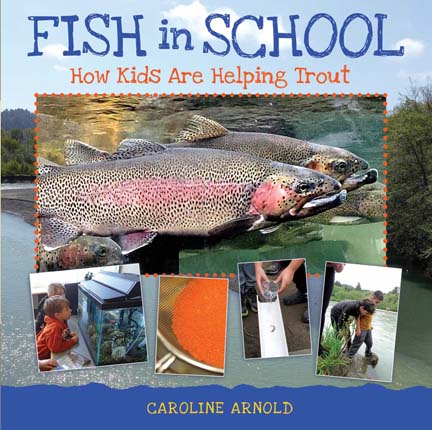
 FISH IN SCHOOL: How Kids Are Helping Trout
Do fish go to school? Sometimes they do. With the help of local fish hatcheries, students and teachers around the United States are giving trout a strong start on their lives in the wild. Follow along as classrooms receive steelhead trout eggs, watch them hatch and develop into fry, and finally release their trout into a nearby river. In the process the students learn about the biology and life cycle of steelhead, the status of the fish in the wild, and the role of fish hatcheries in raising and releasing steelhead.
Setting up your own aquarium.
You can set up your own aquarium at home or at school. You can find out more about raising trout in the classroom by searching the internet and looking for programs in your state.
I never know when I’m going to get an idea for a book. In the fall of 2024 I was doing author visits at schools in Northern California as part of the bi-annual Humboldt County Children’s Author Festival. After my presentation in one of the classrooms, the teacher mentioned that she and her students raise steelhead trout every spring and then release them in a local river. It was part of their science curriculum. I have written many science books for children, including books about raising chicks and butterflies, but had never written about raising fish. This sounded like the perfect new book project for me. When I asked the teacher if she was willing to work with me on this project, she was enthusiastic.
I learned as much as I could by reading articles and watching videos online. I corresponded by phone and email with the teacher whose class I would be writing about. And I talked with the Humboldt County Classroom Aquarium Education Program coordinator. He oversees all the schools in the district that raise fish in the classroom. Onsite visits to two fish hatcheries were also part of my research process.
I needed to observe the students as they participated in the trout in the classroom experience both so I could write about it and also to document it with photographs. I live in Southern California so I had to plan several trips to Humboldt County. My first trip was timed to be there when the fish were spawning at the hatchery and the eggs were delivered to the schools. My last trip was at the end of April when the students released their fish into the river. I took thousands of photos. The challenge is always to choose just the right ones for the book!
Steelhead are excellent long-distance swimmers. I learned that a steelhead trout hatched in a California stream may swim as far north as Alaska after migrating to the sea. When it returns to its hatching place, it is able to recognize it by the smell!
In a project that brings nature into the classroom, California schoolchildren raise steelhead trout from eggs and then release the hatchlings into the wild.
With just the right level of detail to encourage other teachers and students to undertake similar class projects, Arnold describes how eggs donated by a nearby fish hatchery are first placed in an aquarium kitted out with a cooler to maintain the proper temperature. The children carefully attend to the resultant hatchlings over 10 weeks as they mature from alevin to two-inch fry and are then released into a river down which they will travel to the ocean. Along with describing a visit to the hatchery, Arnold lays out the life cycle of the trout, which are closely related to salmon and likewise born in rivers to which the few that survive their many predators return to spawn. She concludes with more information about the specific program she profiles here, as well as further details about the trout’s life cycle and suggestions for other conservation initiatives such as fish ladders for dammed or obstructed spawning rivers. In Arnold’s photos, close-ups of the necessary gear and of the fish at different stages of development alternate with glimpses of light-skinned, racially diverse young students from several schools looking interested and involved.
A model for studying and conserving wildlife, simple and safe. (glossary, range map, further reading) (Nonfiction. 6-8)